
Planting
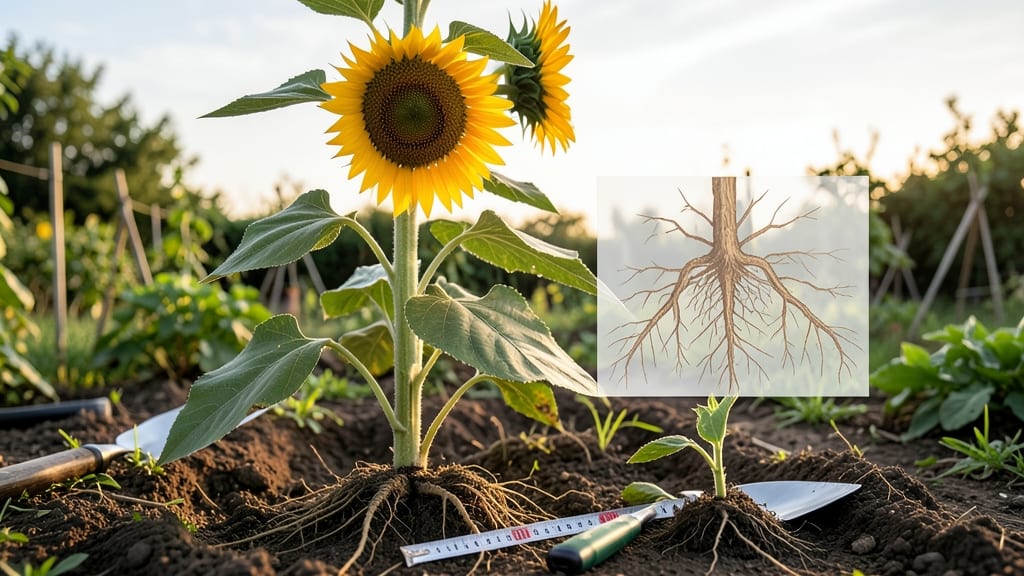
Sunflower roots grow 3 to 5 feet deep—far deeper than most gardeners realize—and that hidden network is what keeps your towering 🌻 standing strong through storms and drought.
Picture this: You’ve poured hours into planting your sunflowers, only to watch them lean or wilt despite what feels like enough water. The issue might not be what you’re doing above ground but what’s happening below it.
Shallow roots struggle to anchor the plant, while deep roots access moisture and nutrients where others can’t reach.
In this guide, I’ll break down exactly how deep sunflower roots typically grow, what factors influence their depth, and how you can optimize your soil to give your sunflowers the strong foundation they need.
Whether you’re dealing with sandy soil that drains too fast or clay that holds water like a sponge, these tips will help your sunflowers thrive from root to bloom.
You’ll also discover practical steps to improve root growth—like proper spacing, soil amendments, and companion planting—so your sunflowers grow taller, sturdier, and more resilient. Let’s dig in!


Sunflower root depth explained: how deep they grow and why it matters
Sunflowers may reach skyward with their towering 12-to-16-foot stalks, but beneath the soil lies an equally impressive root system that anchors their growth. Most gardeners focus on the above-ground beauty, but the real magic happens underground where a deep taproot and sprawling lateral roots work together.
Understanding this hidden structure helps explain why some sunflowers thrive while others struggle—even with perfect care.
On average, sunflower roots extend 12 to 24 inches deep, but this varies based on soil type, water availability, and variety. The primary taproot can penetrate 3 feet or more in loose, well-drained soil, while lateral roots spread horizontally to access nutrients.
This dual system ensures stability and efficient water uptake, especially during drought conditions.
| Root Type | Depth Range | Function | Soil Impact |
|---|---|---|---|
| Taproot | 12–36 inches | Anchors plant, accesses deep water | Struggles in compacted clay |
| Lateral Roots | 6–18 inches (horizontal) | Absorbs nutrients, spreads for stability | Thrives in loose, organic soil |
| Total Root Zone | 18–30 inches deep | Balances water/nutrient uptake | Critical for drought resistance |
In sandy soils, sunflower roots grow deeper and faster to reach moisture, sometimes extending up to 3 feet. This adaptation explains why sunflowers in desert-like conditions can survive with minimal watering.
Conversely, clay-heavy soils restrict root growth, forcing lateral roots to spread wider rather than diving deep, which can weaken the plant’s stability during storms.
The taproot’s depth directly correlates with a sunflower’s height potential. Varieties like Mammoth Russian develop roots 30+ inches deep, supporting their 12-to-16-foot stalks, while dwarf varieties like Teddy Bear have shallower roots (12 inches max) and max out at 3-to-4 feet.
This relationship between root depth and stem height is why gardeners in USDA Zones 3–9 often struggle with sunflowers in urban gardens with shallow topsoil.
Soil depth also affects nutrient absorption. Sunflowers are heavy feeders, requiring phosphorus and potassium for root development. In nutrient-poor soils, shallow roots can’t access these critical elements, leading to stunted growth or yellowing leaves.
Amending soil with compost or aged manure before planting encourages deeper root penetration by improving soil structure and microbial activity.
Regional differences highlight why sunflowers in arid climates (like Arizona) thrive with minimal irrigation, while those in humid regions (like the Pacific Northwest) need consistent moisture to support their root systems.
In containers or raised beds, roots become root-bound if the depth is less than 18 inches, limiting growth. Always choose containers with at least 24-inch depth for standard varieties.
Watering techniques also play a role in root depth. Deep watering (soaking the soil 12–18 inches down 2–3 times per week) encourages roots to grow deeper, while shallow watering promotes weak, surface-level roots.
This is why sunflowers in drought-prone areas develop longer taproots—a survival adaptation that gardeners can mimic by avoiding frequent light watering.
Pest and disease risks increase when roots are crowded or shallow. Sunflowers with restricted root zones are more vulnerable to root rot (from overwatering) or sclerotinia stem rot, a fungal disease that thrives in compacted soils.
Mulching with straw or wood chips helps maintain consistent soil temperature and prevents root stress, while proper spacing (18–36 inches apart) gives roots room to expand.
If you’ve ever planted sunflowers in urban gardens with thin soil, you’ve likely seen the results: leaning stalks or premature wilting. These signs indicate roots can’t anchor the plant or access water deep enough.
To fix this, amend soil with compost, use deep containers, or plant in raised beds with 18+ inches of amended soil. The deeper the roots, the taller—and more resilient—the sunflower.
Next time you admire a sunflower’s height, remember: its underground foundation is just as impressive. By understanding root depth, you’ll grow stronger, healthier plants that withstand drought, storms, and pests—all while reaching new heights.
For even more tips on optimizing soil for sunflowers, check out our next section on ideal planting depth and soil preparation techniques.
Optimal soil depth for sunflowers: how to prepare your garden for maximum growth
Sunflowers thrive when their roots can explore deep into the soil, but most gardeners struggle with compacted urban soil or shallow rural plots. The key to towering sunflowers lies in preparing a minimum 18-inch soil depth, though their roots can extend 3–5 feet deep in ideal conditions.
Without proper depth, your plants will struggle to access water and nutrients, leading to stunted growth or wilting—even with frequent watering.
To create the perfect root environment, start by testing your soil’s drainage and compaction. Heavy clay soils need organic matter amendments, while sandy soils benefit from water-retention additives.
Urban gardeners can use raised beds or deep containers to simulate ideal conditions, while rural plots may require tilling or double-digging to loosen compacted layers.
⚠️ callout warning ⚠️
Sunflower roots grow 12–24 inches deep on average, but can reach 3–5 feet in loose, nutrient-rich soil. Planting in soil shallower than 18 inches restricts root growth, causing:
- 🌱 Wilting during dry spells (roots can’t access deep moisture)
- 🌿 Leaning stalks (unstable anchorage in compacted soil)
- 🌻 Smaller blooms (nutrient competition from shallow roots)
Urban gardeners: Use 5+ gallon containers with drainage holes and compost-rich potting mix.
Begin by amending your soil with 3–4 inches of compost mixed into the top 12 inches of soil. For deeper root penetration, incorporate aged manure or worm castings down to your target depth.
If your soil is clay-heavy, blend in sand or perlite to improve aeration, while sandy soils benefit from peat moss or coconut coir to retain moisture.
Drainage is equally critical—sunflowers hate soggy roots. If your garden holds water after rain, create drainage channels or plant on a slight slope. For containers, ensure they have drainage holes and use a mix with 30% perlite or vermiculite.
Mulching with straw or wood chips helps regulate soil temperature and reduces evaporation, giving roots consistent access to moisture.
Companion planting can also boost root development. Pair sunflowers with beans or peas to fix nitrogen in the soil, or plant marigolds nearby to deter pests that stress roots.
Avoid planting near potatoes or tomatoes, which compete for nutrients. In small spaces, consider dwarf varieties like ‘Teddy Bear’ (2–3 feet tall) that thrive in 12-inch-deep containers.
For maximum growth, water deeply once a week rather than shallow daily sessions. This encourages roots to grow downward in search of moisture. If you notice yellowing leaves or wilting, it’s often a sign roots are struggling—either from compacted soil or insufficient depth.
Adjust your soil prep and watch your sunflowers reach new heights!