
Flowers
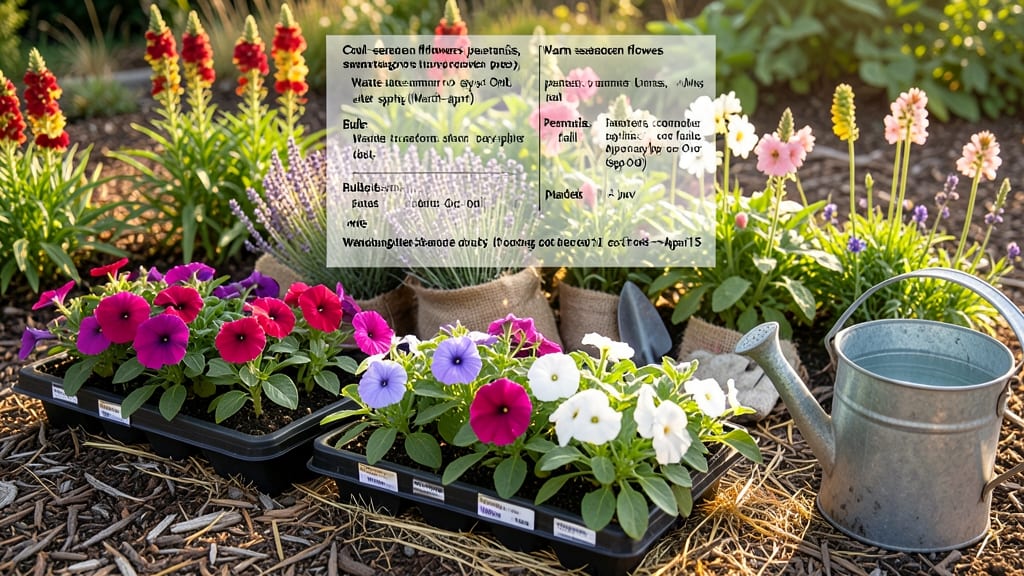
To plant flowers in Washington State, timing depends on your microclimate—whether you’re in the rain-soaked Puget Sound or the dry Yakima Valley, where frost-free dates can shift by months.
Washington State’s diverse climate—from coastal rainforests to high-desert plateaus—means flower planting dates can vary by hundreds of days. Get the wrong timing, and your blooms may never take root. But master these microclimate rules, and you’ll enjoy vibrant gardens year-round.
Most gardeners in Western WA (zones 7b–9a) can start annuals in early spring, while Eastern WA (zones 4b–6a) waits until late April or May to avoid late frosts. Bulbs, however, go in the ground 6–8 weeks before your last frost date—so plan ahead for those early bloomers.
Below, I break down the exact planting windows for your region, plus pro tips for adjusting to Washington’s unpredictable weather—so you can skip the guesswork and get those 🌸 thriving all season.
Washington flower planting calendar by elevation zones
Washington State’s three distinct elevation zones create wildly different planting windows. Coastal areas near Puget Sound enjoy mild winters, while the Yakima Valley faces harsh freezes. Even within 50 miles, your last frost date could shift by weeks. Understanding these zones helps you avoid frost damage and maximize bloom time.
Lowland regions (0–1,000 ft) like Seattle and Bellingham have the longest growing seasons, with frost-free periods stretching from mid-March to November.
Mid-elevation zones (1,000–3,000 ft)—think Snoqualmie Pass or Leavenworth—experience shorter seasons, while highlands (3,000+ ft) like Mount Rainier’s slopes have 50–70 fewer frost-free days.
Here’s how to align your planting with Washington’s elevation-based microclimates:
For lowland gardens, start cool-season flowers like pansies and sweet peas as early as February. These thrive in 50–60°F soil and can handle light frosts.
In mid-elevation zones, wait until after May 1 to plant heat-loving annuals like zinnias or marigolds, as nights can still dip below 40°F.
Highland gardeners should focus on cold-hardy perennials like lavender or Russian sage, which tolerate 30°F temperatures. If you’re in Eastern Washington, use
Best annuals and perennials for each Washington climate zone
Washington’s three distinct climate zones—coastal, inland, and mountain—each demand different flower choices. The coastal region (like Seattle) thrives with humidity-loving annuals like Impatiens and Fuchsia, while inland zones (Yakima Valley) need drought-tolerant perennials such as Lavender and Russian Sage.
Mountain areas (Cascade foothills) favor hardy natives like Penstemon and Lupine, which withstand cold snaps and poor soil.
Native plants like Penstemon and Lupine are my top picks for Washington gardens—they’re low-maintenance, attract pollinators, and often require no extra watering once established.
For example, Penstemon blooms from spring to summer with minimal care, while Lupine thrives in poor, rocky soil, making it perfect for Eastern WA’s dry conditions.
Here’s how to match flowers to your zone, plus their ideal planting months to ensure year-round blooms:
- 🌧️ Coastal Zone (Humid, USDA 7b-9a)
Best for: Annuals like Pansies, Sweet Alyssum, Coleus
Planting Month: March–May (soil temps 50°F+)
Native Pick: Sword Fern (shade-tolerant) - 🌵 Inland Zone (Dry, USDA 4b-6a)
Best for: Perennials like Lavender, Russian Sage, Catmint
Planting Month: April–June (after last frost)
Native Pick: Penstemon (drought-proof) - ❄️ Mountain Zone (Cold, USDA 4b-5b)
Best for: Hardy perennials like Delphinium, Hollyhock, Lupine
Planting Month: May–June (wait for 60°F soil)
Native Pick: Mountain Heather (cold-hardy)
For coastal gardens, prioritize moisture-retentive soil and partial shade for annuals like Impatiens, which wilt in hot, dry conditions. In inland zones, group drought-tolerant perennials together to create a low-water oasis—think Lavender hedges or Russian Sage borders.
Mountain gardens benefit from mulching to insulate roots during freeze-thaw cycles.
Washington’s native flowers are the secret weapon for zero-maintenance gardens. For instance, Oregon Grape (Mahonia aquifolium) thrives in shady, acidic soil and blooms in early spring, while Sagebrush (Artemisia tridentata) handles alkaline, rocky soil in Eastern WA.
These plants outperform non-natives because they’re evolutionarily adapted to local pests and weather.
Pro tip: Start bulbs like Tulips in October–November for early spring color, regardless of zone. Coastal areas can plant tender bulbs (e.g., Dahlias) after Memorial Day, while inland zones should wait until May 15 to avoid frost.
Always check your last frost date—Western WA’s is typically mid-April, but Eastern WA can see frost until early June at higher elevations.