
How To
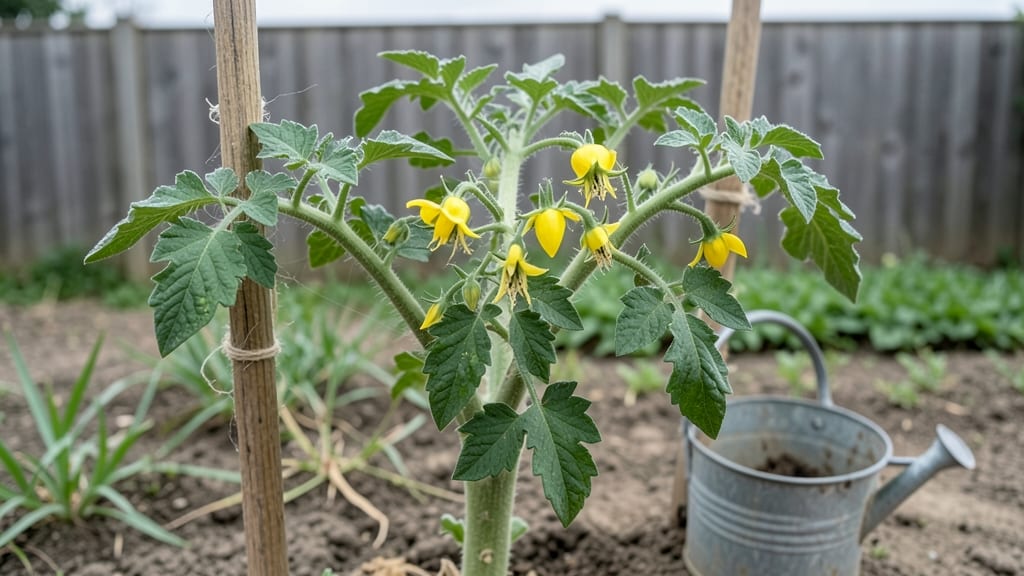
Tomatoes flowering too early often signals stress from heat, drought, or improper light exposure, stunting fruit development. Prune suckers, provide consistent moisture, and relocate plants to cooler, shaded areas to redirect energy toward stronger growth before fruiting.
When tomatoes start flowering before they’re ready, it’s often a sign your plants are under environmental pressure. 🌡️ Extreme heat or cold throws off their natural growth rhythm, forcing them to shift energy from leaf development to reproduction too soon.
I’ve seen this happen most in late spring or early summer when temperatures spike unexpectedly—plants can’t handle sudden swings above 90°F or below 50°F without stressing.
Another common culprit is inconsistent watering, which disrupts nutrient uptake and weakens stems. 💧 Container-grown tomatoes are especially vulnerable here since their roots dry out faster. The key is creating stable conditions: mulch helps retain moisture, while shade cloth (30-50%) can lower leaf temps by 10-15°F during peak afternoon heat.
💡 In This Article
- Environmental Triggers for Premature Tomato Flowering
- Adjusting Care to Delay Tomato Flowering
Environmental triggers for premature tomato flowering
Here's what's actually happening when tomatoes bolt early: their stress hormones kick into overdrive. When temperatures exceed 90°F or drop below 50°F, tomato plants experience what scientists call "thermo-inhibition." This triggers a cascade where ethylene gas—nature's flowering signal—accumulates prematurely.
The plant's natural response is to shift resources from vegetative growth (leaves/stems) to reproductive growth (flowers/fruit), even when the plant isn't physiologically mature. 🔥
The science gets even more interesting with light exposure. Tomatoes need 12-16 hours of daylight for optimal growth, but intense sunlight above 10,000 foot-candles (like full southern exposure) can cause photo-inhibition. This happens when chlorophyll molecules get overloaded, producing reactive oxygen species that damage cells.
The plant perceives this as "stress" and accelerates flowering as a survival mechanism. Container-grown plants are particularly vulnerable because their root zones heat up 10-15°F faster than in-ground plants during heatwaves.
Water fluctuations create another critical trigger. When soil moisture drops below 40% field capacity, tomato roots release abscisic acid—a drought stress hormone that directly stimulates flowering. This explains why plants often flower after a sudden dry spell, even if they had no flowers before.
The key threshold is maintaining soil moisture between 50-70% field capacity—any lower and the hormonal switch flips. 💧
What most gardeners don't realize is how these factors interact. For example, high temperatures (95°F) combined with low humidity (30% RH) create a perfect storm for premature flowering because the plant's stomata (pores) close to conserve water, further accelerating ethylene production.
This is why shade cloth that reduces leaf temps by 10-15°F while maintaining humidity above 50% can dramatically delay flowering in hot climates.
Light quality matters too—blue light wavelengths (400-500nm) promote vegetative growth, while red light (600-700nm) triggers flowering. When summer sunlight shifts toward more red spectrum (especially during long days), it acts like a natural "flowering switch."
This explains why tomatoes often flower more aggressively in June-July than in May, even with identical care. 🌞
One final nuance: different tomato varieties respond differently. Determinate varieties (like 'Roma') are more prone to early flowering under stress because their genetic programming includes a built-in flowering trigger when they reach a certain size.
Indeterminate varieties (like 'Cherry') have more flexibility but still react to environmental cues. Understanding your variety's baseline flowering time helps you recognize when environmental factors are pushing it beyond normal limits.